Shimmer Reverberation
with Nonlinear Feedback Delay Networks

This companion page provides audio examples that showcase the effect of five different nonlinear Feedback Delay Networks (FDNs).

Audio Instructions:Select an audio clip below and click Play to listen to the processed signal mixed with a dry reference. You can also adjust the dry/wet balance and the playhead position to explore the sound characteristics in more detail. A mix value of 100 corresponds to 0% dry / 100% wet, while a mix value of 0 corresponds to 100% dry / 0% wet.

Note:We wanted to showcase as many different scenarios as possible. Which means that some combinations might not sound ideal on all the input signals, but they are nonetheless included to demonstrate a larger range of possibilities.

Quick Index

Structure of the Nonlinear FDN
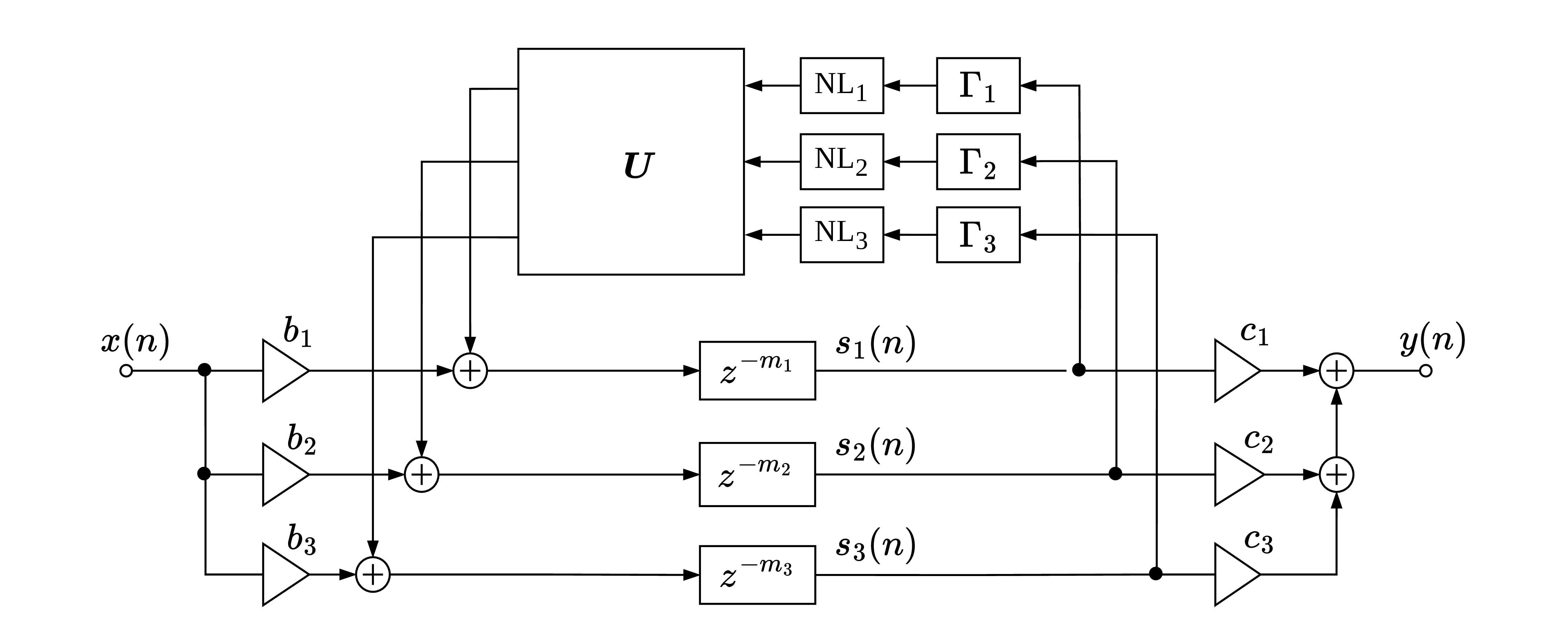
Structure of the nonlinear FDN shimmer reverberation system

Proposed approach: the nonlinear operations \(\text{NL}_i\) are placed in the feedback loop of an FDN. In this configuration, the output of the nonlinearity feeds the orthogonal matrix \(\mathbf{U}\), which distributes it across the FDN channels, generating distinct sound textures depending on the chosen FDN parameters.

Audio Examples

Website vibe-coded with GitHub Copilot (mostly with GPT-5.3 Codex).