Demo page for the paper submitted to Journal of the Audio Engineering Society Audio, special issue on DAFx.
This work investigates the performance of different loss-function configurations for attenuation filters in Feedback Delay Networks (FDNs). In particular, we investigate the Multi Scale Spectral loss (MSS) and the Energy Decay Curve loss (EDC) in both linear (lin) and logarithmic scale (log).
This page includes sound samples of the optimized FDN configurations on 7 measured room impulse responses (RIRs) and 3 additive noise sequences. The samples are divided into two signal-to-noise ratio (SNR) conditions, and the results contain only the noise-free RIR to better assess the performance of the framework in tuning the attenuation filters.
The RIRs belong to the datasets "OK5: Spatial Room Impulse Responses from 25 Spaces in our Work Environment" by de la Heras S. et al. (2026, https://doi.org/10.5281/zenodo.18622201) and "Chamber music hall acoustics: Measurements and perceptual differences" by W. Lachenmayr et al. (2023, https://doi.org/10.1121/10.0020066).
The ambient noise sequences are taken from the dataset "TAU Spatial Room Impulse Response Database (TAU-SRIR DB)" by Politis A. et al. (2022, https://doi.org/10.5281/zenodo.6408611).
A plot of the Energy Decay Relief (EDR) of the clean reference, or of the difference in EDR between the clean reference and target, can be downloaded by clicking on "EDR Plot". Mean absolute errors across time and frequency bins are reported in the table.
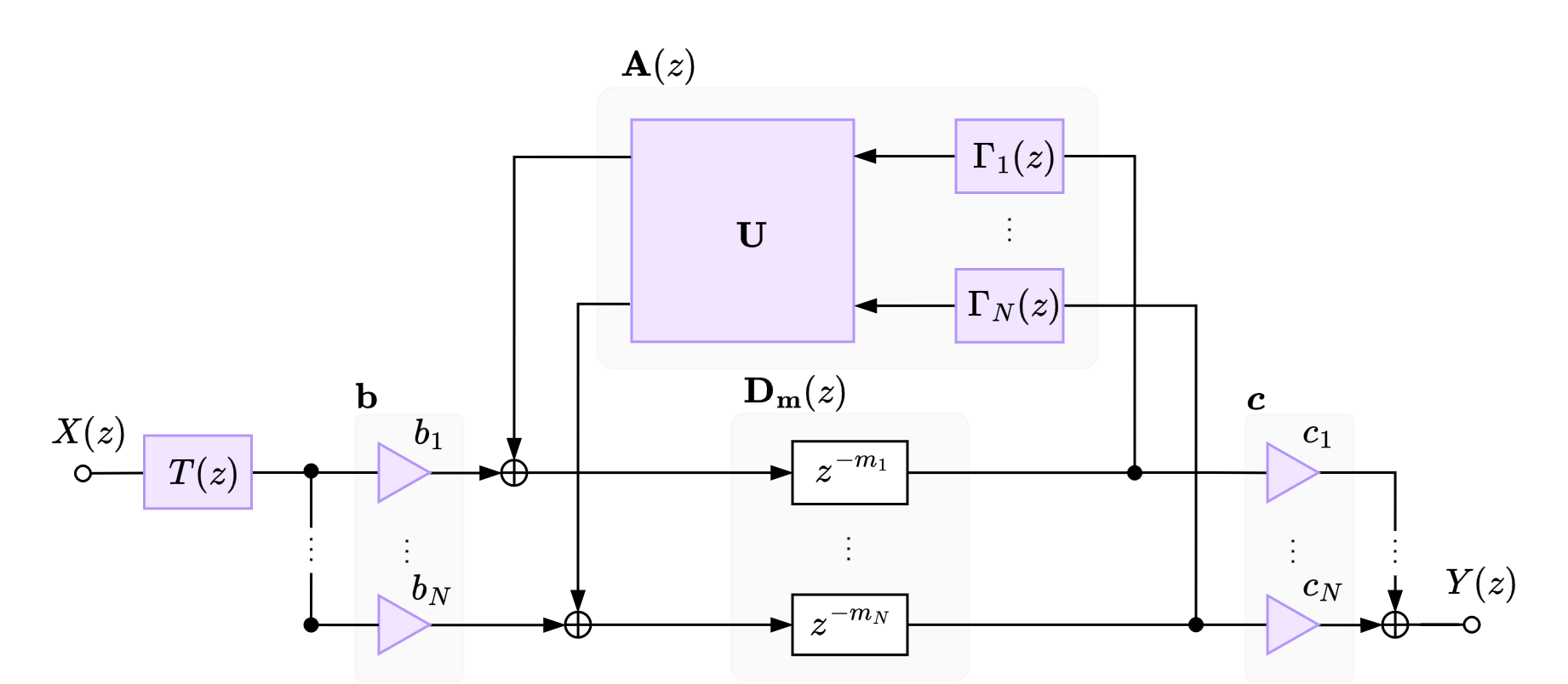
The FDN structure is shown in the figure below, where the blocks in purple are being tuned by the optimization framework. The code is available at GitHub.