Shimmer Reverberation
with Nonlinear Feedback Delay Networks

Gloria Dal Santo, Xiaojie Pi, Karolina Prawda, Sebastian Schlecht, and Vesa Välimäki

This companion page provides audio examples that showcase the effect of five different nonlinear Feedback Delay Networks (FDNs).

Audio Instructions:Select an audio clip below and click Play to listen to the processed signal mixed with a dry reference. You can also adjust the dry/wet balance and the playhead position to explore the sound characteristics in more detail. A mix value of 100 corresponds to 0% dry / 100% wet, while a mix value of 0 corresponds to 100% dry / 0% wet.

Note:We wanted to showcase as many different scenarios as possible. Which means that some combinations might not sound ideal on all the input signals, but they are nonetheless included to demonstrate a larger range of possibilities.

@inproceedings{dal2026shimmer,
  title={Shimmer reverberation with nonlinear feedback delay networks},
  author={Dal Santo, Gloria and Pi, Xiaojie and Prawda, Karolina and Schlecht, Sebastian and Välimäki, Vesa},
  booktitle={29th International Conference on Digital Audio Effects (DAFx)},
  pages={40--47},
  year={2026},
  month={Sept.},
  address={Cambridge, MA, USA},
}

Quick Index

Structure of the Nonlinear FDN
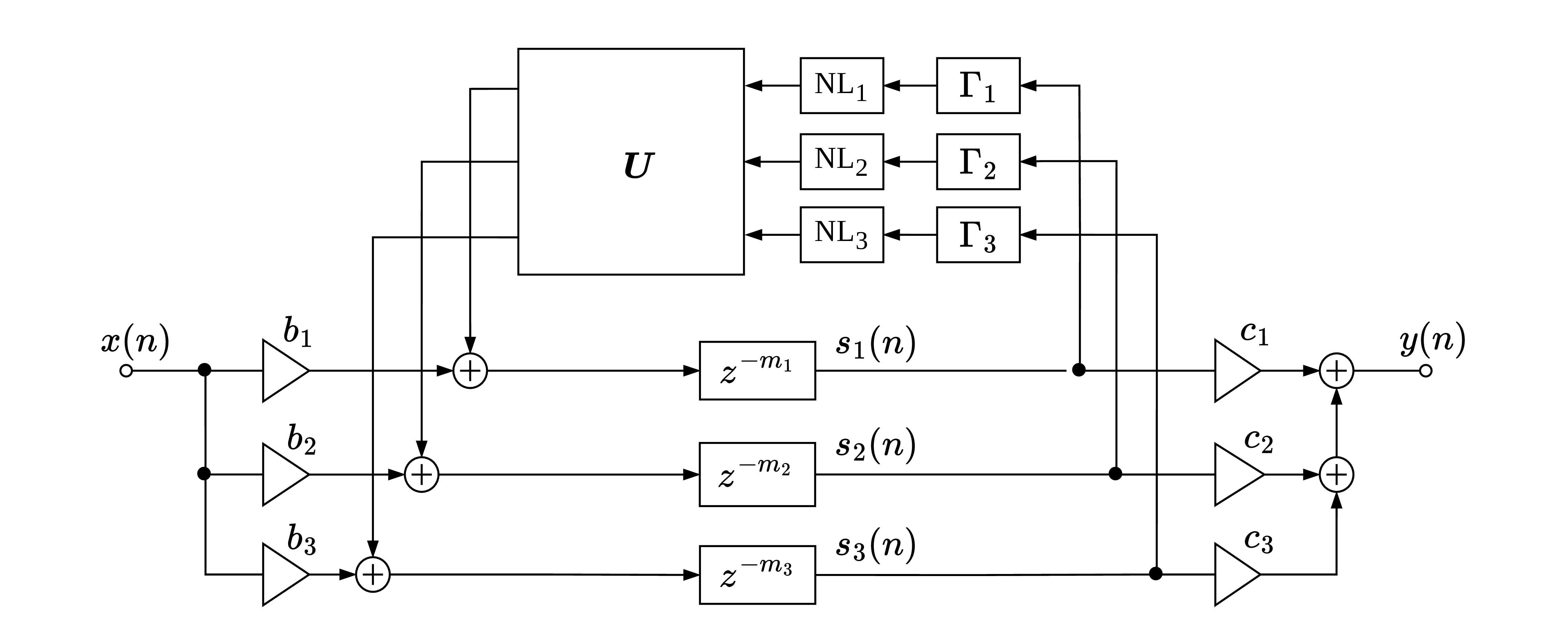
Structure of the nonlinear FDN shimmer reverberation system

Proposed approach: the nonlinear operations \(\text{NL}_i\) are placed in the feedback loop of an FDN. In this configuration, the output of the nonlinearity feeds the orthogonal matrix \(\mathbf{U}\), which distributes it across the FDN channels, generating distinct sound textures depending on the chosen FDN parameters.

Audio Examples

Website vibe-coded with GitHub Copilot (mostly with GPT-5.3 Codex).

↑